I’ve started thinking you can tell quite a lot about a school before the students even arrive.
Just look at the INSET timetable.
Seriously.
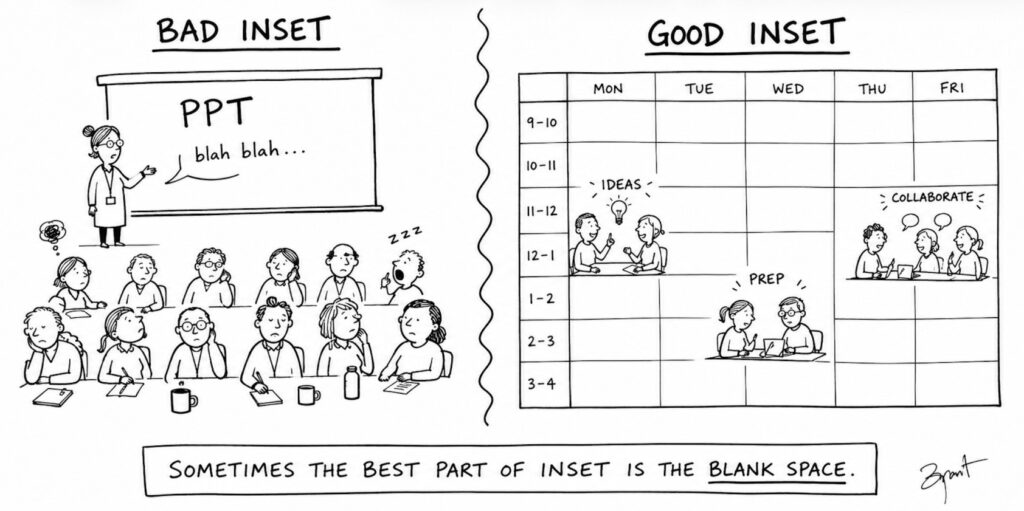
That first week tells you what the school thinks teachers need. It tells you what they value. And, probably more importantly, it tells you how much they trust the people they hired.
The best schools?
Their INSET timetable has empty spaces.
Actual empty spaces.
“Department time.”
“Planning.”
“Classroom preparation.”
Sometimes it just says something vague like “Professional time”.
And then they leave you alone.
At first that can almost feel strange. Surely somebody has forgotten to schedule a meeting?
But no. They hired teachers and they’re assuming those teachers probably know what they need to do before 25 students walk into the room on Monday morning.
And that’s the bit I really like.
Because empty time during INSET isn’t empty at all.
Someone is rewriting a unit that didn’t quite work last year. Someone is sitting with a new colleague explaining how the course runs. Two teachers are looking at last year’s results and wondering why one topic went badly. Someone else is sorting the first three weeks of lessons because they know that once school starts, that lovely free afternoon isn’t coming back.
There might even be time to sit with your department and actually talk about teaching.
Imagine that.
There’s quite a lot of research around professional development which basically backs this up. Desimone’s work talks about things like active learning, collaboration, content focus and professional development being connected to the actual work teachers do.
Which sounds obvious when you say it like that.
But somehow we still manage to design INSET where teachers spend six hours listening to people talk about improving teaching.
Then there are the good schools.
They still give you some of this time, just less of it.
Fair enough.
There are things every school needs to cover. Safeguarding. New systems. Exam results. Policies. Priorities for the year. New staff need introductions. Sometimes everybody genuinely does need to be in the same room.
No issue with that.
It’s what happens after that which matters.
Do you get time to go back to your department and work out what any of this actually means?
Or does the next PowerPoint immediately start?
Because there’s another type of school.
You probably know this one.
The INSET calendar looks like Tetris.
Every box filled.
8:00 Welcome.
8:30 Vision.
9:15 Strategic priorities.
10:00 Coffee.
10:15 New initiative.
11:00 Data.
12:00 Lunch.
13:00 Workshop.
14:00 Another workshop.
15:00 Whole-school meeting.
15:45 Department meeting.
16:30 “Classroom preparation”.
Forty-five minutes.
Lovely.
And these can sometimes be the schools whose LinkedIn pages are absolutely flying.
Professional photographer on site.
Drone footage.
Leadership team walking slowly through a corridor.
A graphic announcing that some magazine has named them one of the “Top 50 Schools in the World”.
Everything looks fantastic.
Meanwhile the maths teacher is wondering when they’re actually supposed to plan maths.
That’s the strange bit.
We talk constantly about teacher workload and then, when teachers are finally in school without students, we sometimes fill every minute for them.
Even the meeting research is pretty uncomfortable here. Luong and Rogelberg found that more meetings were associated with greater feelings of fatigue and workload.
Again, nobody needed a PhD to suspect this.
Still nice to have the paper.
And I’m not anti-meeting.
Some things need meetings.
If we need to make a decision, let’s meet.
If we need to argue something out, let’s meet.
If departments need to agree how we’re assessing something, absolutely.
But if you’re going to spend twenty minutes telling 80 teachers something which could’ve been written in six lines…
That meeting could genuinely have been an email.
Actually, sometimes it could’ve been the subject line of the email.
And by the third or fourth meeting like this, people aren’t really listening anyway.
They’re thinking about their classrooms.
The new class they’ve never taught before.
That unit they still haven’t planned.
The email they need to send.
The seating plan.
The student with additional needs they wanted to read about.
The lesson on Monday morning.
Which brings me to cognitive load.
We use cognitive load theory all the time when we’re talking about students. Working memory is limited. Don’t swamp students with unnecessary information. Reduce things that take mental effort without helping the actual learning. De Jong describes this nicely when discussing extraneous cognitive load.
And then we organise INSET as if teachers have unlimited working memory.
New safeguarding procedure.
New MIS.
New reporting expectations.
New strategic priority.
New behaviour system.
New AI policy.
New assessment calendar.
New mission statement.
Now…
“Okay everyone, you’ve got 25 minutes to think creatively about your curriculum.”
Good luck.
To be clear, cognitive load theory wasn’t written about INSET days. I’m stretching the idea into a different context here.
But it does make you wonder.
If we accept that human beings have limited cognitive capacity when they’re sitting in our classrooms, presumably they don’t magically receive a RAM upgrade when they become teachers.
And then there’s my favourite INSET activity.
Display boards.
I have nothing against a nice classroom.
I like a nice classroom.
But I’m slightly worried when the display board seems to have a higher priority than the curriculum.
Three hours making sure every wall has the correct coloured border.
Twenty minutes discussing what Year 10 are actually going to learn.
Something feels backwards there.
And weirdly, there is research on this too.
Fisher, Godwin and Seltman taught kindergarten children in classrooms with different levels of visual decoration. In the highly decorated classroom, the children were more distracted, spent more time off task and made smaller learning gains.
Now obviously this doesn’t mean we should walk around ripping posters off every classroom wall.
They were young children. It was a specific study.
But it does make the obsession with filling every available centimetre of classroom wall slightly funny.
Sometimes a blank wall is just a blank wall.
It doesn’t mean the teacher has given up.
And maybe the same thing is true of an INSET timetable.
A blank space doesn’t mean leadership has run out of ideas.
Sometimes it means they trust you.
There was a large study of teacher autonomy in England by Worth and Van den Brande which found that autonomy was associated with job satisfaction, feeling that workload was manageable and intentions to stay in teaching.
The bit I found most interesting was professional development.
Teachers having influence over their own professional development goals was particularly strongly associated with job satisfaction.
That makes sense to me.
Teachers are professionals.
Most of us know where we’re weak. We know which class needs sorting out. We know which curriculum area needs work. We know which colleague we need to sit down with for an hour.
Sometimes the most useful thing leadership can say is:
“You’ve got the afternoon. Use it well.”
And then actually mean it.
There’s also a systematic review by Vangrieken and colleagues looking at 82 studies on teacher collaboration. The overall picture is pretty clear. Proper teacher collaboration can have benefits for teachers, students and the school.
But collaboration needs time.
You can’t put “collaboration” on a school improvement plan and then timetable every teacher’s day down to the minute.
And professional development needs time to turn into something as well.
One of the more recent pieces of research I came across looked at 104 randomised trials of teacher professional development. Sims and colleagues talk about PD helping teachers develop insight, motivation and techniques, but also actually embedding those changes into practice.
That last bit matters.
Because sitting in a session isn’t the same as changing what happens in your classroom.
At some point you’ve got to open the laptop.
Change the lesson.
Rewrite the assessment.
Talk to the colleague.
Move things around.
Try something.
That’s work too.
Maybe that’s actually the most important work of INSET.
So these days, when I see an INSET programme, I don’t really judge it by how impressive the session titles sound.
I look for the gaps.
How much time do teachers actually have?
How much department time is there?
Can people sit together?
Can somebody close their classroom door for two hours and just get ready?
Or has every available minute been claimed by somebody who has something to tell them?
Because the first lesson a school teaches its staff each year happens before any students arrive.
It’s there in the timetable.
This is what we think matters.
And, perhaps more importantly: this is how much we trust you.
References
de Jong, T. (2010) ‘Cognitive load theory, educational research, and instructional design: some food for thought’, Instructional Science, 38, pp. 105–134. doi: 10.1007/s11251-009-9110-0.
Desimone, L.M. (2009) ‘Improving impact studies of teachers’ professional development: Toward better conceptualizations and measures’, Educational Researcher, 38(3), pp. 181–199. doi: 10.3102/0013189X08331140.
Fisher, A.V., Godwin, K.E. and Seltman, H. (2014) ‘Visual environment, attention allocation, and learning in young children: When too much of a good thing may be bad’, Psychological Science, 25(7), pp. 1362–1370. doi: 10.1177/0956797614533801.
Luong, A. and Rogelberg, S.G. (2005) ‘Meetings and more meetings: The relationship between meeting load and the daily well-being of employees’, Group Dynamics: Theory, Research, and Practice, 9(1), pp. 58–67. doi: 10.1037/1089-2699.9.1.58.
Sims, S., Fletcher-Wood, H., O’Mara-Eves, A., Cottingham, S., Stansfield, C., Goodrich, J., Van Herwegen, J. and Anders, J. (2025) ‘Effective teacher professional development: New theory and a meta-analytic test’, Review of Educational Research, 95(2), pp. 213–254. doi: 10.3102/00346543231217480.
Vangrieken, K., Dochy, F., Raes, E. and Kyndt, E. (2015) ‘Teacher collaboration: A systematic review’, Educational Research Review, 15, pp. 17–40. doi: 10.1016/j.edurev.2015.04.002.
Worth, J. and Van den Brande, J. (2020) Teacher autonomy: How does it relate to job satisfaction and retention? Slough: National Foundation for Educational Research.