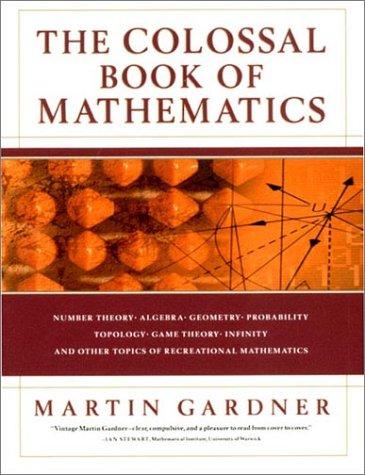
Martin Gardner spent decades writing the Mathematical Games column for Scientific American, and this book collects some of the finest material from that extraordinary run. If you are not already familiar with Gardner’s work, this is an excellent place to start. If you are, you will know exactly why a collection of this scope is worth having in one place.
The book covers an almost absurd range of topics. Combinatorics, number theory, topology, probability, logic puzzles, geometry and much more are all represented here, each treated with the wit, clarity and genuine mathematical seriousness that defined Gardner’s writing throughout his career. The pieces were written to be accessible to a general reader but they were never dumbed down, and that combination is rarer than it should be.
What Gardner understood better than almost anyone is that mathematics is most compelling when it is surprising. Every chapter in this book contains at least one idea that makes you stop and think, something that seems impossible until it is explained, or something familiar that turns out to be stranger than you expected. That quality of genuine intellectual surprise is hard to manufacture and Gardner produced it consistently for decades.
For students, the book works on multiple levels. Some chapters can be read purely for enjoyment. Others open doors to areas of mathematics that standard curricula never touch. For teachers, it is an inexhaustible source of enrichment material, problems and starting points for mathematical conversations.
I would recommend this to anyone who loves mathematics and wants a book they can return to again and again. Gardner is one of the great popularisers of the subject, and this collection is a fitting monument to that achievement.