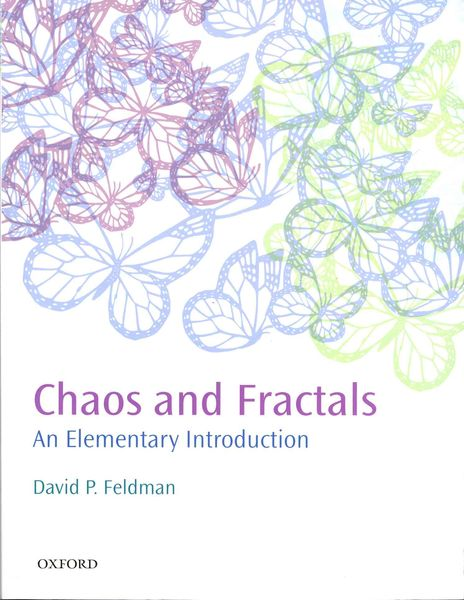
Chaos and fractals are topics that fascinate almost every mathematically curious student the moment they encounter them, yet finding a book that introduces the ideas properly without either dumbing them down or demanding graduate-level prerequisites is surprisingly difficult. Feldman’s Chaos and Fractals: An Elementary Introduction is one of the few that genuinely manages it.
The book assumes relatively little prior knowledge, making it accessible to strong sixth form students and early undergraduates alike. Feldman builds the key ideas from the ground up, starting with iteration and dynamical systems before working towards the deeper concepts of chaos, strange attractors and fractal geometry. Each step is motivated clearly, so the reader always understands not just what is being done but why it matters.
What sets this book apart from popular science treatments of the same topics is that it actually does the mathematics. There are equations, there are proofs, there are exercises, and the reader is expected to engage with them. At the same time, Feldman never loses the thread of the bigger picture. The mathematical details serve the ideas rather than obscuring them, which is harder to achieve than it sounds.
The chapters on fractals are particularly well done. The progression from simple geometric constructions to the concept of fractal dimension is handled with real care, and the connections to natural phenomena are drawn in a way that feels genuine rather than forced.
For any student who has ever looked at a Mandelbrot set and wanted to understand what is actually going on beneath the surface, this book is an excellent place to start. I recommend it warmly.