Several years ago, a colleague walked into our department office looking visibly distressed. She filled her water bottle and drank almost a litre in one go. She was usually cheerful, energetic and bubbly, but not that day. I knew something was wrong.
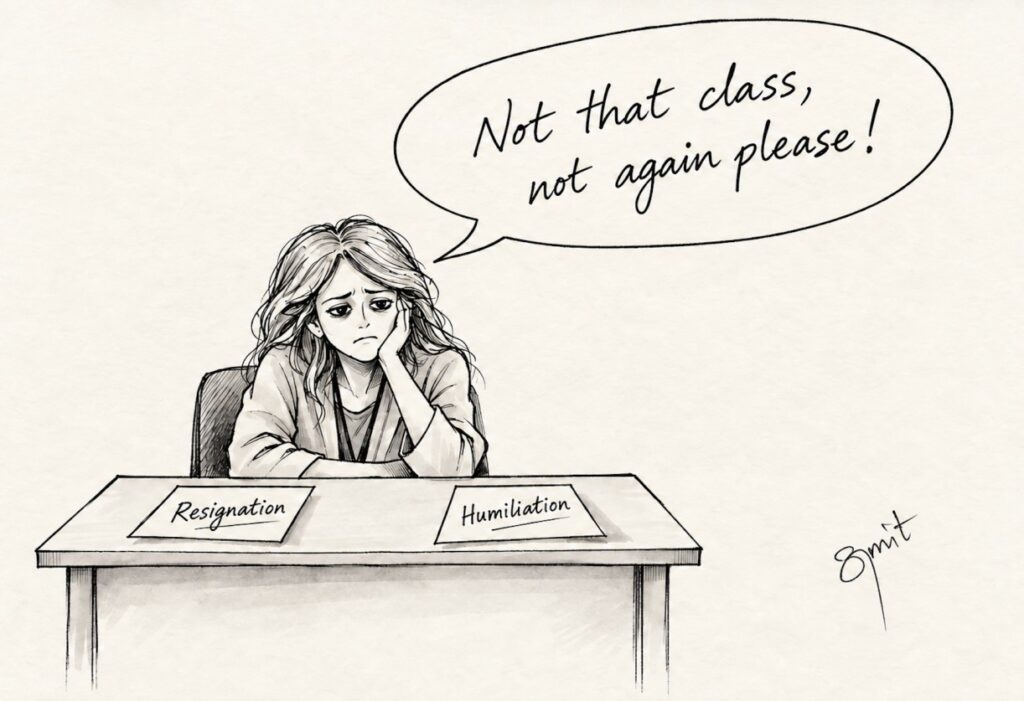
Pic credit: Initial caricature made by yours truly with final touches given by Mrs. Raj
“Are you okay?” I asked.
“Yes,” she replied, before pausing. “It is just my Grade 9 class. They keep imitating some strange ‘internet Indian accent’ and are not letting me teach. The students who genuinely want to learn are suffering. I have tried everything. I contacted parents and wrote to the Head of Year, but there is nothing more I can do.”
She then told me that the behaviour was no longer directed only at her. It was also being pushed towards a newly arrived student.
“I will speak to the Head of Secondary,” she said, “but I do not think anything is going to change. I need this job. Please do not tell anyone about this, Amit.”
She was one of the finest Mathematics teachers I had encountered. She knew her subject deeply, cared about her students and worked hard to make Mathematics accessible. Yet none of that protected her from being reduced to an accent.
It was racialised humiliation disguised as harmless classroom banter.
We knew who the students were. We also knew that they made better behavioural choices with other teachers. They understood where the institutional boundaries were firm and where they could continue pushing them. Their behaviour was not simply the result of immaturity. It was also shaped by their perception of power, status and consequence.
At the time, the online rivalry between T-Series and PewDiePie was at its height. Mocking Indian names, accents and identities had become part of the internet humour consumed by many young people. In the classroom, that humour did not remain harmless or virtual. It gave students a shared language through which they could humiliate a teacher and isolate a new student while continuing to call it a joke.
This happened before the global reckoning on racism that followed 2020, when schools began speaking more openly about diversity, inclusion and belonging. Students and former students started sharing their experiences. They spoke about the blatant and casual racism they had faced within institutions that proudly described themselves as international.
Some of the schools with the strongest reputations were among those being questioned.
I later received messages from former students describing their own experiences. Their stories suggested that the language used by schools had changed more quickly than the lived reality of their communities. “Belonging” had entered mission statements, professional development sessions and strategic plans, but the central question remained:
What happens when someone says, “I do not feel safe here”?
Arrival is not the same as belonging
The newly arrived student in my colleague’s class had technically joined the school. Their application had been processed. They had received a timetable, entered a classroom and possibly attended an orientation.
But had they truly been welcomed?
This is where the idea of safe passage becomes important.
Safe Passage Across Networks, known as SPAN, is an independent nonprofit organisation and a Supporting Member of the Council of International Schools. SPAN focuses on healthy transitions and attachment security. It encourages schools to consider the needs of those arriving, those leaving and those remaining behind. CIS welcomed SPAN as a Supporting Member in 2022, with the organisations working together to raise awareness of transitions-care, advance research and support international-school communities. CIS, 2022
Safe passage does not simply mean moving someone successfully from one place to another. It means helping them preserve and rebuild their sense of security, identity and connection while they move between schools, countries, cultures or stages of education.
CIS has since developed its Educational Transitions Framework, which brings attention to five connected areas: well-being, purpose and pathways, learning environment, relocation, and connections and belonging. It promotes a whole-institution approach involving teachers, counsellors, safeguarding teams, pastoral leaders, students and families. CIS, Educational Transitions
This matters because a transition is not completed when a student learns where the library is or how to access the school platform. A student has not experienced safe passage if they enter a community in which their identity immediately becomes a source of entertainment.
My colleague’s experience revealed something deeper. The mockery directed at the new student was not an isolated weakness in the school’s induction programme. The student was entering a culture in which an established and highly accomplished teacher, who shared aspects of their identity, was already being treated as less worthy of respect.
The student could see what happened to someone who spoke like them.
That communicates something far more powerful than any welcome presentation.
When transitions-care meets anti-discrimination
SPAN helps us understand the importance of connection and attachment during transition. However, SPAN is not a complaints body and does not investigate racism in schools. The racism in this story is more directly connected to CIS’s work on safeguarding, identity-based harm, and inclusion through diversity, equity and anti-discrimination.
The International School Wheel of Safety and Belonging, shared through CIS, asks school communities to consider how characteristics such as race, ethnicity, culture, language and accent affect a person’s access to safety and belonging. It challenges schools to look beyond visible diversity and examine how power and marginalisation operate within their communities. CIS, International School Wheel of Safety and Belonging
This distinction matters. A school may have an excellent orientation programme and still tolerate racism. It may assign a student buddy and still fail to challenge discriminatory humour. It may celebrate international day while members of its community remain afraid to report what is happening to them.
Transitions-care and anti-discrimination must therefore work together.
A welcoming programme cannot create belonging if the wider culture tolerates humiliation. A buddy system cannot compensate for leaders failing to respond. Orientation cannot be considered successful merely because a student understands the timetable.
The real test is whether the student feels safe enough to speak, participate, make mistakes and remain fully themselves.
The digital world enters the classroom
The problem has become more complicated. Online hate does not remain online. Social-media content enters classrooms through jokes, imitated accents, edited videos, memes and stereotypes.
Today, generative AI makes it possible to create manipulated images, cloned voices and fabricated videos within minutes. UNESCO has warned that digital platforms and generative technologies can amplify harmful narratives, hate speech and social polarisation. The United Nations has similarly expressed concern about the mass reproduction of racist and discriminatory content through social media and artificial intelligence. UNESCO, 2026
Schools cannot control everything students encounter online. They can, however, decide what happens when that material is brought into the classroom and used against another person.
Do we dismiss it as banter?
Do we focus only on whether the lesson was disrupted?
Do we place the burden on the targeted person to demonstrate that the behaviour was serious enough?
Or do we recognise that an attack on someone’s accent may also be an attack on their ethnicity, culture, history and right to participate with dignity?
Belonging must be experienced
Belonging cannot be measured by the number of nationalities represented in a school brochure. It cannot be demonstrated only through flags, food festivals or carefully selected photographs.
It must be experienced in ordinary classrooms, corridors and staffrooms.
It is present when a newly arrived student knows that their identity will not be used against them. It is present when a teacher can raise a concern without fearing damage to their career. It is present when leaders respond consistently, even when the students involved are influential, popular or difficult to challenge.
My colleague’s words have stayed with me:
“I need this job. Please do not tell anyone.”
She was not simply struggling with one difficult class. She had reached a point where remaining silent felt safer than asking the institution to protect her dignity.
We often speak about teachers creating safe classrooms, nurturing relationships and ensuring that every child feels seen. But belonging cannot be delivered as a strategy by adults who do not experience it themselves.
If a member of staff does not feel a strong sense of belonging, how can they ensure that a child feels they belong at school? Let me know what you think in the comment.
References
- Council of International Schools. Safe Passage Across Networks becomes a CIS Supporting Member, 2022.
- Council of International Schools. Educational Transitions.
- Council of International Schools. Five ways to embed transitions-care within and between schools, 2022.
- Council of International Schools. The International School Wheel of Safety and Belonging, 2023.
- Safe Passage Across Networks. About SPAN.
- UNESCO. Media and Information Literacy: Countering hate speech in the digital age, 2026.