Stephenson’s Mathematical Methods for Science Students has been around for decades, and there is a good reason it keeps getting recommended. It is one of those quietly reliable books that does exactly what it says on the cover, without fuss and without unnecessary padding.
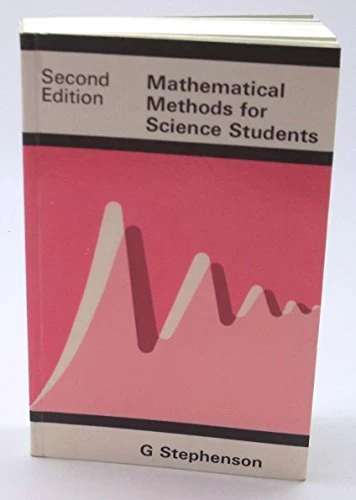
The book is aimed squarely at students in the physical sciences and engineering who need a solid grounding in the mathematical tools their disciplines demand. It covers a broad range of topics including differentiation, integration, differential equations, vector analysis, matrices and Fourier series, all presented in a style that is clear and methodical. Stephenson writes with the kind of economy that experienced teachers appreciate. There is no wasted space. Every section earns its place.
What I particularly like is that the book does not assume the reader already thinks like a mathematician. It meets students where they are and builds up steadily. The worked examples are well chosen and the exercises give students enough practice to develop genuine confidence rather than just surface familiarity with the techniques.
It works well as a course companion but also holds its own as a self-study resource. I have pointed students towards it when they are struggling to bridge the gap between school mathematics and the demands of a first-year science or engineering course, and it has consistently served them well.
If you are teaching or studying in a science-related field and want a dependable, no-nonsense mathematical methods text, this is a strong choice. I recommend it without hesitation.