For years, LinkedIn rewarded people who could make simple ideas sound complicated.
Not necessarily the people with the best ideas.
Not necessarily the people with the deepest expertise.
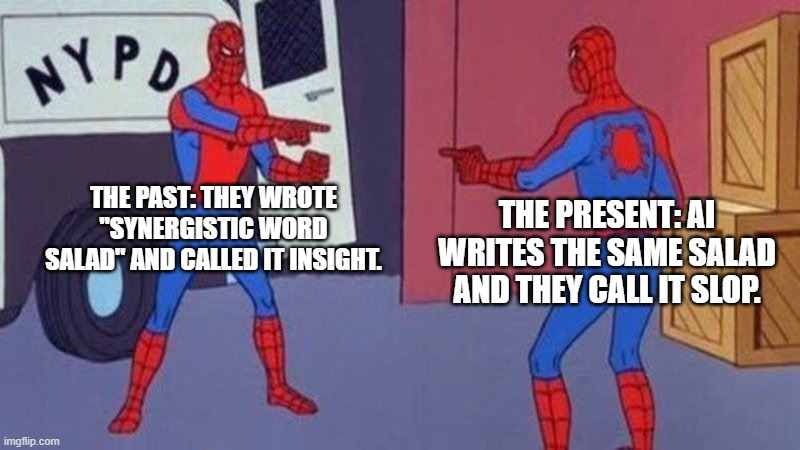
Just the people who could package ordinary thoughts in polished corporate English.
Some built entire careers around sounding intelligent without actually saying very much.
Now AI has arrived and suddenly these same people are panicking about “AI slop.”
Interesting.
Because what AI is really destroying is linguistic gatekeeping.
A brilliant engineer in Bengaluru or a teacher in Cairo may already have exceptional ideas, but expressing them in polished native-level English has always required extra labour. The hard part was often not the thinking. It was the translation.
AI reduces that friction.
And yes, some people use AI badly. LinkedIn is now full of dramatic posts about “leadership journeys,” “unlocking synergies,” and breakfasts that apparently changed someone’s entire mindset.
But that is not an AI problem.
That is an empty thinking problem.
The difference now is that polished language alone is no longer enough.
When everyone has access to decent writing, the real differentiator becomes:
- Do you actually understand your field?
- Can you think clearly?
- Can you verify information?
- Can you apply knowledge meaningfully?
This is no different from calculators in mathematics.
Giving everyone a calculator did not make everyone a mathematician.
Students still need number sense because without understanding, they cannot tell when the calculator is wrong.
AI works exactly the same way.
These systems hallucinate constantly. Without subject knowledge, many users cannot distinguish insight from confident nonsense.
That is why expertise matters even more now, not less.
The future does not belong to people who reject AI.
It also does not belong to people who blindly outsource thinking to it.
It belongs to people who can use AI without surrendering judgment.
And honestly, some of the outrage around “AI slop” feels less like concern for authenticity and more like discomfort that the old fluency hierarchy is collapsing.
The gate is no longer guarded by vocabulary.