What Teaching Mathematics in Different Countries Taught Me?
4 May 2026
7 min read
There was a moment, sitting in a curriculum planning meeting in Dubai, when I realised that the way I thought about mathematics teaching had been shaped by systems I had not consciously chosen. I was drawing simultaneously on frameworks from three entirely different educational traditions, each absorbed in a different country, each one invisible to me until I found myself using all of them at once. That moment of noticing stayed with me. It turned out to be the beginning of a more deliberate kind of learning about what mathematics education can be.
What the Indian system gave me
My foundational education in mathematics happened in India, and it gave me something I continue to rely on every day: computational fluency, intellectual discipline, and a deep respect for mathematical structure. I learned to calculate with speed and accuracy, but more importantly, I learned that mathematics demands precision. A result is not “close enough”. It is either correct or it is not.
There was also a cultural dimension to this learning that is often overlooked. Mathematics, in many Indian classrooms, carries a certain intensity. It is rigorous, competitive, and at times relentless. But within that, I also found something unexpectedly valuable. Mathematics became, in its own way, therapeutic. There was clarity in it. A sense that problems, however complex, could be worked through step by step.
Approaches like Vedic Mathematics, whether used formally or informally, reinforced flexibility in thinking and mental agility. They encouraged looking at numbers in multiple ways, not just through a single prescribed method. That stayed with me, even as I later encountered more structured Western approaches to problem solving.
What the system offered less of, at least in my experience, was space for sustained exploration. The emphasis was often on arriving at correct answers efficiently rather than spending time with uncertainty or developing multiple pathways to a solution. It produced students who were exceptionally strong in examination settings, but not always equally comfortable when faced with unfamiliar or open-ended problems. I have carried the strengths forward. I now work more deliberately to address the gaps.
What the UAE taught me about diversity
Teaching in Dubai changed my understanding of what a mathematics classroom actually contains. At JESS Dubai and then at the Swiss International Scientific School, I taught students whose mathematical backgrounds spanned at least a dozen different curricula. A single class might include students formed by the Indian system, the British national curriculum, the American Common Core, the Australian curriculum, and the IB framework, each bringing a different mathematical vocabulary, a different relationship to proof, and different assumptions about what school mathematics is supposed to accomplish.
This was demanding in ways that no single-system environment had prepared me for. It also revealed something important: mathematical knowledge is not as portable across curricula as we tend to assume. A student who is genuinely strong in one system can appear weak in another, not because their understanding has changed, but because the framing has. Teaching in the UAE taught me to assess what a student actually knows rather than where they appear to sit within whichever framework I happened to be using at the time.
What Singapore showed me about curriculum design
I have not worked within the Singapore system directly, but I have worked closely with teachers who have been trained in it and have had the opportunity to observe its influence through their practice. That indirect exposure has been enough to recognise how deliberately the system is constructed.
Singapore’s mathematics framework places problem solving at the centre, with concepts, skills, processes, metacognition, and attitudes organised around it. What stands out is not just the structure itself, but the consistency with which it is implemented. Problem solving is not treated as an extension activity. It is treated as the purpose of mathematics education.
Teachers who have worked within that system bring a level of clarity about progression that is difficult to ignore. There is a strong sense of what students have encountered, what they are expected to apply next, and how different ideas connect over time. This kind of vertical alignment does not happen accidentally. It reflects long-term curriculum design and sustained investment in teacher development.
Engaging with colleagues shaped by that system has made me more aware of how much curriculum coherence matters, and how easily it can be lost when schools adopt frameworks without fully aligning their teaching practices to them.
What Switzerland is teaching me now
Working from Switzerland has changed my relationship to mathematics education in a different way. As a consultant rather than a classroom teacher, I now move between schools at different stages of their development, each navigating the IB continuum from its own particular starting point. What this vantage point reveals most clearly is the gap between curriculum intent and classroom reality.
Schools can adopt an IB framework with genuine commitment and still find, several years later, that their mathematics departments are teaching to the examination in a way that is not meaningfully different from a traditional high-stakes model. The IB’s ambition for mathematics education, the emphasis on inquiry, exploration, and deep conceptual understanding, is genuinely different from what most national curricula require. Living up to that ambition takes consistent professional development, honest self-review within departments, and a real willingness to examine whether what is being delivered matches what the framework actually promises. That is work I find both demanding and genuinely valuable to support.
What school visits have taught me about context
One of the most valuable parts of my current role has been the opportunity to observe mathematics classrooms across different schools and systems. Sitting in lessons, speaking with teachers, and seeing how the same curriculum is interpreted in different environments has added a layer of understanding that no single school experience could provide.
What becomes clear very quickly is that mathematics teaching is deeply shaped by context. The same IB framework can look entirely different depending on the school’s history, leadership, student demographic, and even parental expectations. In some classrooms, inquiry is genuine and sustained. In others, it is present in language but not yet in practice.
Observing colleagues has also been a reminder that good teaching is often highly local. Strategies that work exceptionally well in one setting do not automatically transfer to another. What matters is not adopting a model wholesale, but understanding why it works where it does, and what needs to change for it to work elsewhere.
These visits have made me more cautious about generalisations and more attentive to nuance. They have also reinforced something simple but important: improving mathematics education is less about finding a perfect system and more about continuously refining practice within the realities of each school.
The one thing every system gets wrong
Across all four contexts, the consistent underestimation has been this: mathematical confidence matters alongside mathematical competence, and the two are not the same thing. Systems that produce technically able students who are afraid of unfamiliar problems, who shut down when a question does not fit a known pattern, are not producing mathematically capable people in any complete sense. They are producing examination performers.
The student who can engage with an unfamiliar problem, who can tolerate not knowing the answer immediately, who can think flexibly across mathematical ideas, is the student who will carry mathematics forward into their life and work. Every system I have taught within has occasionally produced students like this. None has done it reliably or consistently enough.
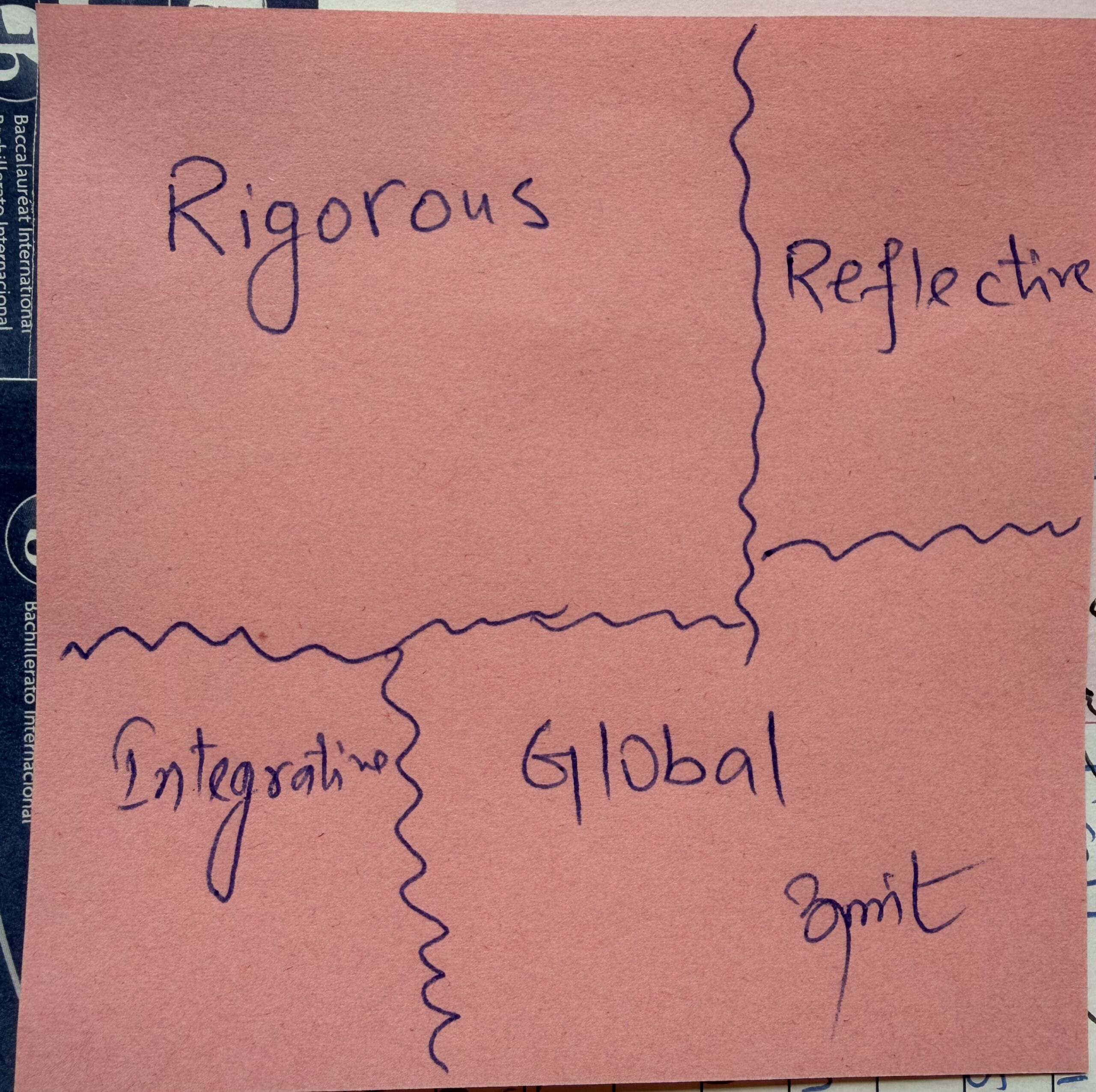
I have carried something forward from every place I have taught, and I am still working out what to do with all of it. The honest observation, after teaching across multiple contexts and now supporting schools across the IB continuum, is that no single tradition has solved mathematics education. What works tends to be the combination: rigour and inquiry together, fluency in service of understanding, and teachers who know their subject deeply and genuinely care about the students in front of them.
If any of this connects to challenges your school is working through, I would be glad to talk. You can find me at amitraj.org/#contact.